Coverings
A covering is a set of cells at one resolution, standing for an area of the globe, possibly in disjoint parts, such as the output of polygonToCells or sphericalCap. It is stored compacted, and in general should be used with methods expecting compacted data. If the actual cells are required (for example for a JOIN operation) a covering should be uncompacted first (warning: could use a huge amount of memory).
The functions on this page combine, query and measure coverings:
Example processing flow
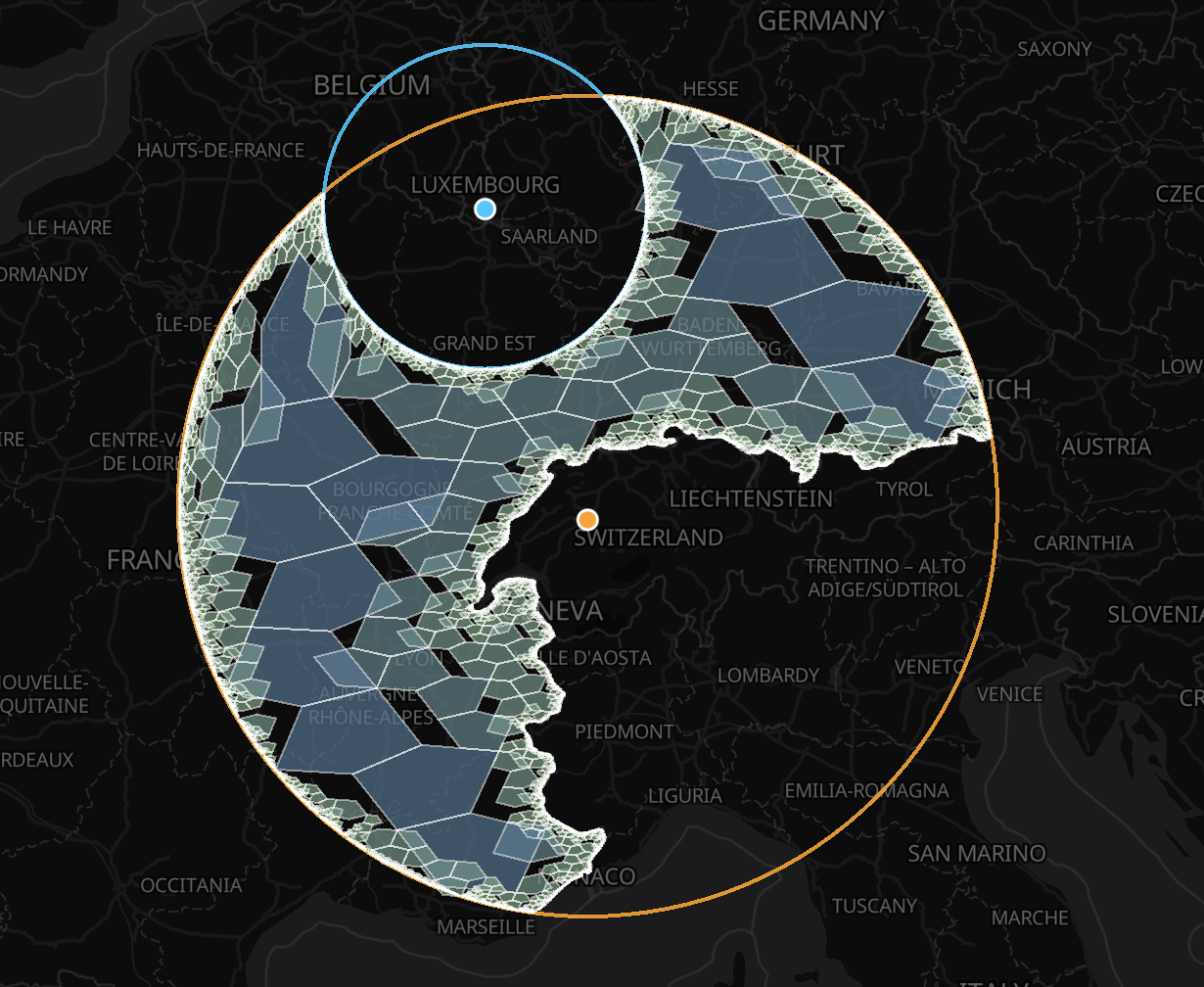
// Construct coverings
let france = polygon_to_cells(&france_polygon, 18, None)?; // 944ms -> 1.09 billion cells
let germany = polygon_to_cells(&germany_polygon, 18, None)?; // 708ms -> 718 million cells
let near_bern = spherical_cap(bern, 400_000.0)?; // 302ms -> 1.02 billion cells
let near_luxembourg = spherical_cap(luxembourg, 150_000.0)?; // 113ms -> 143 million cells

// Set operations
let france_and_germany = union(&france, &germany)?; // 7.0ms -> 1.81 billion cells
let also_close_to_bern = intersect(&france_and_germany, &near_bern)?; // 5.4ms -> 646 million cells
let but_far_from_luxembourg = difference(&also_close_to_bern, &near_luxembourg)?; // 3.2ms -> 545 million cells

// Area of covering, to the nearest resolution 18 cell (~500m²)
println!("{} km²", area(&but_far_from_luxembourg)? / 1e6); // 1.4ms -> 269516 km²

// Point in polygon
println!("{}", contains(&but_far_from_luxembourg, munich)?); // 50ns -> true
Timings measured with the Rust implementation on an Apple M1 Pro.
Set operations
union
Returns the cells in either covering. Both must be at the same resolution, or it throws.
a5_union(a UBIGINT[], b UBIGINT[]) -> UBIGINT[]Parameters
a(bigint[] | BigUint64Array) First coveringb(bigint[] | BigUint64Array) Second covering
Return value
- (BigUint64Array) Combined covering of both input coverings
Example
-- A multi-polygon: the union of its partsSELECT a5_union(a5_geometry_to_cells(mainland, 10), a5_geometry_to_cells(island, 10)) AS coverageFROM parts;intersect
Returns the cells in both coverings. Both must be at the same resolution, or it throws.
a5_intersect(a UBIGINT[], b UBIGINT[]) -> UBIGINT[]Parameters
a(bigint[] | BigUint64Array) First coveringb(bigint[] | BigUint64Array) Second covering
Return value
- (BigUint64Array) Covering of cells present in both input coverings
difference
Returns the cells in the first covering but not in the second. Both must be at the same resolution, or it throws.
a5_difference(a UBIGINT[], b UBIGINT[]) -> UBIGINT[]Parameters
a(bigint[] | BigUint64Array) Covering to subtract fromb(bigint[] | BigUint64Array) Covering to subtract
Return value
- (BigUint64Array) Covering of cells present in the first covering but not the second
Example
-- A country without the area within 50 km of its capitalSELECT a5_difference( a5_geometry_to_cells(geom, 10), a5_spherical_cap(a5_lonlat_to_cell(capital_lon, capital_lat, 10), 50000)) AS outsideFROM countries;Predicates
contains
Checks whether a cell is in a covering. The cell must be at the covering's resolution, or it throws: A5 cells don't nest geometrically across resolutions, so a finer cell isn't guaranteed to lie inside its ancestor. To test a point, index it at the covering's resolution with lonLatToCell(point, resolution).
a5_contains(cells UBIGINT[], cell UBIGINT) -> BOOLEANParameters
cells(bigint[] | BigUint64Array) Sorted coveringcell(bigint) Cell to test, at the covering's resolution
Return value
- (boolean) Whether the cell is in the covering
Example
SELECT a5_contains(a5_geometry_to_cells(geom, 12), a5_lonlat_to_cell(2.35, 48.85, 12)) AS insideFROM countries;overlaps
Checks whether two coverings share any cell. Both must be at the same resolution, or it throws.
a5_overlaps(a UBIGINT[], b UBIGINT[]) -> BOOLEANParameters
a(bigint[] | BigUint64Array) First coveringb(bigint[] | BigUint64Array) Second covering
Return value
- (boolean) Whether some cell is in both coverings
Measures
count
Returns the number of cells in a covering, equivalent to the length of uncompact(cells) without having to materialize the uncompacted cells. Note that this generally differs from the length of the compacted array.
a5_count(cells UBIGINT[]) -> UBIGINTParameters
cells(bigint[] | BigUint64Array) A covering
Return value
- (bigint) Number of cells at the covering's resolution. A
bigint, as it can exceedNumber.MAX_SAFE_INTEGERat high resolutions
Example
-- Stored compactly, as 78929 cells at mixed resolutionsSELECT a5_count(a5_geometry_to_cells(geom, 16)) -- 67995098 cells at resolution 16FROM countriesWHERE name = 'France';area
Returns the area of a covering in square meters. As A5 cells are equal-area, this is exact: the number of cells times the cell area at the covering's resolution.
a5_area(cells UBIGINT[]) -> DOUBLEParameters
cells(bigint[] | BigUint64Array) A covering
Return value
- (number) Area in square meters